
Love Musicals? There’s a certificate for that! Whether you’ve been performing since you could walk or you just can’t stop playing the Hamilton cast album, the Musical Theatre Certificate is for you, regardless of your major! In just 21 credits, you’ll dive deep into the history, performance, design, and music that makes this art form unlike any other.
Program Description
The Musical Theatre Certificate offers a liberal arts musical theatre curriculum for undergraduate students with a range of interests and experiences. The certificate requires 21 credits with 12 credits of required courses within the Department of Theatre Arts, 6 credits of required courses within the Department of Music, and 3 elective credits from among a selection of classes offered in both departments.
Musical Theatre is inherently interdisciplinary. A comprehensive understanding of musical theatre is not possible without understanding the history, theory, and practice of performance, music, dance, and design. The certificate provides beginning students with an opportunity to start exploring musical theatre performance and advanced students with upper-level electives to further build their musical theatre performance skills and practice. In hands-on classes, students will learn foundational skills in the design and spectacle used in big Broadway shows through small café cabarets. Students will learn more about musical theatre history, contemporary production, and approaches to analysis through courses on musical theatre from its beginning to the present. Courses also explore the fundamentals of music and its relationship to narrative. Through its broad approach to the subject, this certificate allows students from any major the ability to pursue in-depth study of musical theatre.
The Musical Theatre Certificate serves all students interested in musical theatre, whether they have only watched shows as an audience member or have performed in and worked on many musical theatre productions. Whether students want to simply learn more about musical theatre or further refine their practice as a musical theatre artist, the program is designed to serve diverse student interests while fostering dialogue across disciplines.
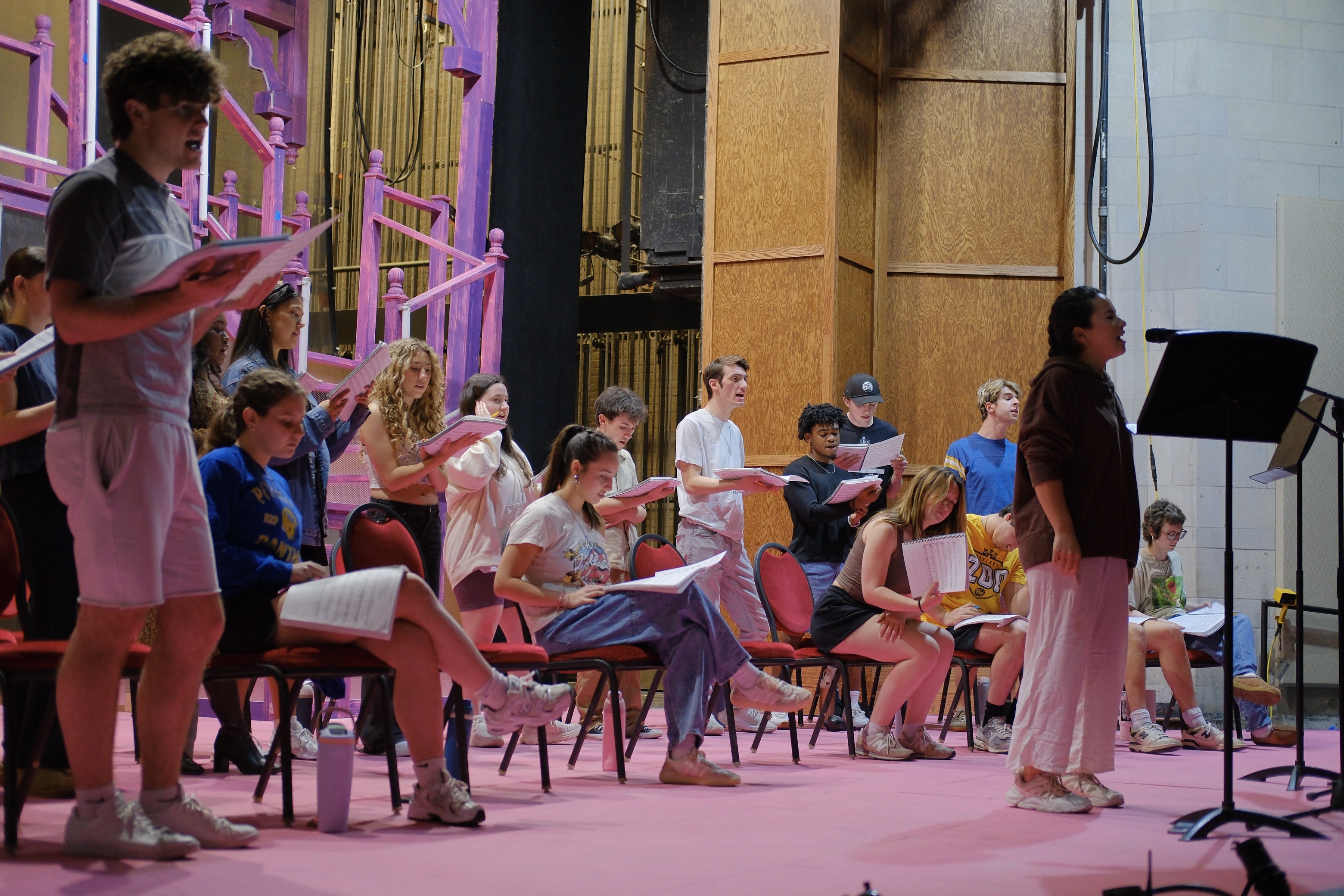
Although not required by the certificate program, students with an interest in musical theatre practice are encouraged to explore production opportunities in the Departments of Music and Theatre Arts. The Department of Theatre Arts’ musicals welcome all students to audition, apply to serve as designers and dramaturgs, help backstage, or even be an assistant to a director.
Interested in learning more about the Department of Theatre Arts and its offerings? Email stages@pitt.edu and ask to be added to our email list!
*Curriculum Plan
The certificate will require 21 credits: 12 credits from Theatre Arts, 6 credits from Music, and 3 credits of Musical Theatre Electives. Completion of the Certificate will be certified by the Director of Undergraduate Studies in Theatre Arts. Questions? Contact Gianni Downs for more information.
Courses
Theatre Arts Courses
THEA 1410-Musical Theatre Appreciation
This course is designed to investigate the history of Musical Theatre and to gain a greater appreciation for the art form through listening, script analysis, and critical examination. Students will explore the genre through scenes and songs, observation of professional performance followed by critical response, and guest demonstrations. No experience in performance is necessary for participation.
THEA 1338-Musical Theatre Performance I
This course is designed to introduce students to the foundational elements of the musical theatre performer’s process and to examine the use of song in a theatrical context as a mode of human expression. Students will be introduced to the fundamentals of vocal structure and technique as well as physical and vocal presence in front of an audience within the context of specific genres/ style periods of musical theatre. Fundamental acting techniques will be developed in the context of musical theatre practice through the use of regular warm-ups, theater games, improvisation, and study of song texts. Each of the three main units of the course, ensembles, duets and solo songs, will culminate in a public performance of the pieces studied in class. Standard professional practices for musical preparation and auditions will also be addressed and will include a mock audition process at the end of the term. Students will be required to attend a full production of a musical and will develop critical analytical skill through written reflection on that production as well as on their own development throughout the term.
THEA 1339-Musical Theatre Performance 2
This process-based course focuses on the application of foundational techniques introduced in Musical Theatre Performance 1 to collaborative scene work. Students will cultivate personalized warmups, create strategies for learning music independently, and engage in advanced text study and analysis. Students will explore the body to brain connection and sing with integration of text and technique. Meaningful memorization will be emphasized and applied through weekly solo, small group, and ensemble performances in class time. Students will be encouraged to seek out local auditions, connect with professional musical theatre performers, and learn best practices for audition repertoire selection and preparation. Students will be required to attend two full productions of live musicals and use their critical analytical skills to compare and contrast the performances and material. (3 credits)
THEA 1407-Intro Musical Theatre Design
This is an introductory course in the theory, process, and techniques of set, costume, sound, and lighting design. The course will look at musical theatre scripts and learn to apply design concepts to these texts utilizing class discussion and projects. Students will learn to develop artistic and conceptional approaches to storytelling and how to implement these concepts into theatre design. This course will also investigate how designers’ partner with technology in creating the environment of productions within the spectacle of musical theatre. Industry standards in design principles, technology, and script analysis will be explored. (3 credits)
THEA 1408-Immigrants and Musical Theatre
This course examines how immigrants helped shape musical theatre into the form audiences know and love today. It also will analyze the transformation of musical theatre’s representation of immigrants over three centuries. Through the analysis of race, ethnicity, class, gender, and sexuality, the class will examine how the experiences of immigrant artists and musical theatre representation reflected, responded to, and rebelled against prevailing anxieties and tensions surrounding immigrants in U.S. society and globally. (3 credits)
THEA 1409-Queer Broadway
The American musical has long found its most devoted and enthusiastic fans in LGBTQ+ communities. This class is less concerned with why this has come to pass than how. Moving across memoirs, cast recordings, activist protest, daytime television, diva worship, social media, cruise ships, drag shows, and experimental theatre, we will examine how queer communities engage musical theatre to various social, cultural, and political ends. While focusing on LGBTQ+ communities, we will also draw upon the insights of queer theory to analyze how musicals generate “queer” forms of attachment for people inhabiting a range of identities in and beyond the United States. (3 credits)
THEA 1410-Musical Theatre Dance History
This course explores the history of dance, choreography, and corporeality related to American musical theatre. Students will interrogate critical sociological narratives regarding dramaturgical bodies and dance from the beginnings of seventeenth-century ballet through twenty-first-century hip-hop. In this class, students will garner a thorough understanding of vital innovations in the industry by key choreographers such as Katherine Dunham, Agnes De Mille, Jerome Robbins, Bob Fosse, Camille A. Brown, Sergio Trujillo, and Andy Blankenbuehler. Students will develop necessary vocabulary and foundational theories throughout the semester in order to situate and analyze bodies, dance, and choreography historically and critically. Activating a wide range of case studies, the class will conceptualize the functions of dance within musical theatre as well as how dancing bodies communicate and amplify fundamental storytelling.
Music Courses
MUSIC 0100-Fundamentals of Music
This class provides a comprehensive introduction to reading and understanding tonal music. It is intended for music majors preparing to enter the music theory sequence, or for non-majors who wish to learn to better understand and produce musical notation. Topics include pitch, rhythm and meter, scales, intervals, chords, and harmony. By the end of this semester, you will be able to identify basic harmonic progressions and musical forms both visually and aurally. Prior experience with music theory is neither required nor assumed. If you feel that this course may be review, you may be able to exempt out of it by taking an exam.
MUSIC 0211-Introduction to Western Art Music
This class will examine the history, culture, and practice of ”’classical”’ music. We will explore the technical workings of music and learn what to listen for in a wide variety of musical styles. We will also discuss the values and meanings of music in different social and political contexts. No prior knowledge of music is necessary and there is no requirement to read music to succeed in the course.
MUSIC 0411-Theory 1
This course is designed for beginning to intermediate music theory students. It introduces tonal melody and harmony, and may cover topics such as chord progressions, inversions, lead sheet symbols, non-chord tones, and/or voice leading.
MUSIC 0896-Music and Film
This introductory course, designed for non-majors with no previous background in music or film studies, examines music within the context of film, instructing students how to listen and think critically about the music and its relationship to the moving image and narrative.
MUSIC 1253-Listening to Live Music Performance
Listening to Live Music Performance is a course that hopes to deepen the way you understand music and, through new understanding, inspire the way you experience music! Over the course of the semester, we will explore, without prejudice, a variety of live music performances that will help you develop a lifelong ability to analyze music performance, think critically about the act of listening to music, and to consider your critical role as a member of the audience. The purpose of this class is to transform your experience with music by focusing on live performance. Music is a ubiquitous part of our everyday lives, so much so that many people have lost the ability to listen critically to what they are hearing. In many contexts, we are not even aware that music is playing until it is brought to our attention! Recorded music accounts for much of this ubiquity and it’s also changed many listeners’ relationship with music. Throughout the semester, we will explore the experience of listening to live performances of music, which may include large ensembles, chamber ensembles, solo concerts, and multi-media performances. Topics will include protocol and traditions of the audience, criteria for critical listening, and discrimination of basic elements of performance. Students will attend live performances, consider evaluative criteria for music performances, and develop critical listening skills. We will also have opportunities to speak with performers to learn about various ways of experiencing music. We are interested in developing critical skills to experience, analyze, and appreciate the myriad musical styles and contexts you will encounter over a lifetime of listening. To that end, this class is focused totally on the act of critical, experiential listening, how to do it, informed listening, and what it can tell the listener’s not only about a piece of music, but about the culture and society that created that music, as well as the challenges faced by the increasing ubiquity of music in our world. You do not need a musical background to have a successful semester. Through listening, reading, and associated assignments, the objective is to deepen your experience of music.
MUSIC 1271-The Sounds of Romantic Comedy
Sometime between Ernst Lubitsch’s The Shop Around the Corner (1940) and Nora Ephron’s You’ve Got Mail (1998), romance changed in the United States. Where class and wealth used to be deciding factors for romantic love, there now emerged the concept of the soulmate, who could be anyone. In this course, we will watch American romantic comedies of the last 100 years, paying particular attention to how the development of the soundtrack has changed what love sounds and feels like. Students will develop skills in closely analyzing sound and image in film, critically interpreting popular culture in relation to broader events in society, and thinking about the relation between music, identity, and politics. In particular, we will together develop answers to the following questions: how did capitalism, social justice movements, the changing nature of work, and other cultural transformations affect what people expected from intimate union? What aesthetic norms for representing romance changed alongside cultural norms? How is the narrative of love inflected by race, gender, ethnicity, sexuality, religious difference, ability difference, and/or economic disparity?
At Pitt, we believe theatre should be accessible to everyone: auditions and portfolios are never required to join our program or enroll in classes. Once you are a Pitt student, you are welcome to participate in the Department of Theatre Arts in any way that inspires you. First-year students are invited and encouraged to audition for our productions, as our stages are open to all students across the University, from any school or major.