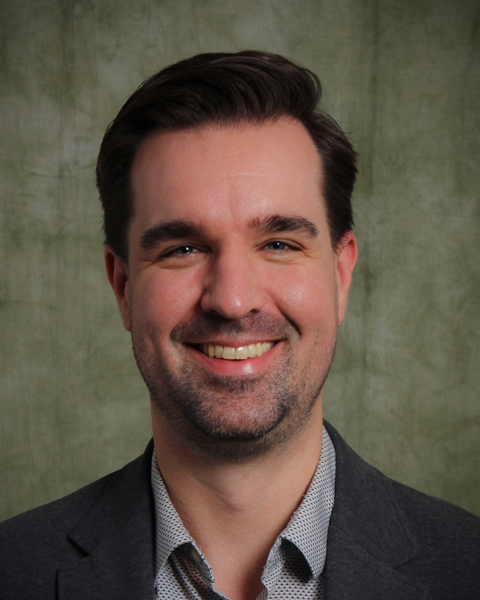
Dr. David Bisaha is an Associate Professor of Theatre History and Theory at Binghamton University, SUNY where he studies performance design history and the history of immersive and participatory performance. His book American Scenic Design and Freelance Professionalism was published by Southern Illinois University Press in 2022.
Why did you decide to go to graduate school?
I did my MA and PhD at Pitt. I pursued the MA because I was interested in dramaturgy, after I studied it in undergrad and worked at a literary internship after graduation. There wasn’t much work specifically in dramaturgy in my prior studies, and so graduate school was a logical next step. I was also interested in the skills, network, and experience graduate school could provide. Along the way, I discovered theatre history and performance studies, and became more interested in teaching, academic research, and the blend of theatre practice and study possible in a university setting. To prepare for that, I decided to continue from the MA into a PhD program.
Why did you choose to pursue your degree at Pitt?
When I was first looking at Pitt, I wanted to be a production dramaturg and was considering both MA and MFA programs at the time. I first became aware of Pitt because I had done an honors conference, presenting part of my undergraduate thesis, and I had Bruce McConachie as a respondent. This was more than a year before I applied to Pitt, and I had no sense that I would want to become a theatre historian. But Bruce ended up being my dissertation advisor – so you never know what paths might come from one-off opportunities!
When I was deciding whether to stay for the PhD or to study elsewhere, it was a combination of the strength of the faculty, my relationships with the graduate cohort, and the support package that led to my staying at Pitt for the PhD.
How did the degree program help prepare you for your career?
My MA and PhD studies are essential for my career. My area knowledge, research and writing skills, pedagogy, career development, and approach to mentorship and advising all have roots in Pitt’s education. Pitt gave me room to develop and change during my time there. It supported teaching through coursework and repeated practice in the classroom as a TA, and it helped me refine my research area and skills through seminars, one-on-one advising, and career development. Having a supportive cohort of fellow students, too, helped me practice the skills of networking: conversation, generous criticism, mentorship, and just getting to know new people in the peculiar environment that is academia.
What is your current position and what does it involve?
I’m an Associate Professor of Theatre at Binghamton University, SUNY. I teach theatre history, literature, dramaturgy, and performance studies. My research is in performance design history, and this is my first year as Associate Editor for Theatre Annual. (Send us your stuff!) At Binghamton we have a standalone MA program, which is designed to help prepare domestic and international students for further work in the study or practice of theatre, a BA in theatre, and a new BFA in musical theatre. So, I am reading and writing, editing, and teaching courses from theatre history to musical theatre dramaturgy and immersive performance criticism.
There is also a service component, which I think is important to mention because it often goes unremarked. Service involves work that helps my department run (planning, curriculum, hiring), helps my university run (I’m currently on committees for general education and graduate student travel grants), and helps the field run (aforementioned editing, and I’m an officer of the American Theatre and Drama Society, ATDS). This is also work that you can start in graduate school, through a graduate organization or committee assignment. I think this is helpful because it helps you build a network and speak about service convincingly (and with examples) in a campus visit, for instance.
Thoughts and/or advice for current graduate students?
Read, and write, and be open to growth and change. The world of academia is differently precarious today than it has ever been. Old advice may not be fully relevant today. Take what makes sense to you, because it’s your career ultimately. Listen for the difference between advice that is hard to hear because it is challenging you to grow, and advice that is no longer applicable to the world we now inhabit.